Audience
Department-wide
Purpose
This procedure sets out the department's approach to managing health, safety and wellbeing (HSW) risks. It explains what must be done, who is responsible, and how the department keeps workers and others safe from harm.
Detailed guidance, tools and templates that support the application of this procedure are available within the risk management element of the HSW Management System (HSWMS) and must be utilised when applying risk management processes.
This procedure provides the overarching requirements for managing HSW risks across department operations. However, where a specific HSW procedure exists for a particular hazard or activity (e.g. asbestos management), that procedure must be followed.
Overview
The department must, so far as is reasonably practicable, protect workers and other persons from harm arising from HSW hazards associated with its operations through effective risk management.
Risk management is a systemic process used to:
- identify hazards and risks
- assess the level of risk
- implement effective control measures
- monitor and review effectiveness over time.
This procedure applies to:
- all workers, contractors, visitors and others
- all departmental workplaces including schools, regional and corporate environments
- all work activities including planning, delivery, operations and change management
- all HSW hazards and risks including physical and psychosocial hazards.
Note: An exception to the application of this procedure is where a hazard or risk specific procedure exists. In these cases, that procedure must be followed (e.g. asbestos management).
Risk management must be applied:
- proactively (planning and design stages)
- reactively (in response to unplanned events/incidents or changes)
- continuously (as part of normal operations).
This procedure should be read in conjunction with the Health, safety and wellbeing policy, Enterprise risk management policy, procedure and framework.
The HSWMS Risk Management element contains the supporting resources that provide detailed instruction on how risk management requirements are applied in practice.
Responsibilities
Workers
- Identify, record and report all hazards, incidents and near misses.
- Participate in risk management activities where required including HSW risk assessments.
- Implement controls and safe work practices specified in the department's HSWMS, do not remove or weaken them.
Workplace/school supervisors, managers and delegates
These are leadership roles in workplaces or schools who have accountability for managing risks within their work area or authorised activities. This may include deputy principals, heads of department, business managers and directors. A person may hold more than one role and both sets of responsibilities apply.
Within their area/scope, they must:
- ensure all workers understand and apply HSW risk management processes
- record identified hazards and manage them in line with department and site-specific processes, escalating high-risk matters promptly
- facilitate risk assessments for the work area or authorised activities and consult with relevant stakeholders
- approve risk assessments at the appropriate level
- ensure controls are implemented, maintained and remain effective
- monitor and review risk assessments regularly.
Person in charge of a workplace/school
Typically, this is the principal, workplace manager, director, or other person with overall responsibility for the management of a workplace. They must:
- implement, communicate, monitor and review site-specific HSW risk management processes with the HSW committee or equivalent consultative platform
- ensure risk assessments are completed and all hazards are recorded
- maintain a current list of known hazards and their controls in MyHR Workplace Health and Safety
- ensure health and safety representatives (HSRs) have access to information relating to hazards and risks relevant to their work group
- ensure all workers are familiar with control measures, participate in training and information sharing
- escalate high-risk matters requiring higher level approval
- only accept a medium or high residual risk where the risk cannot be eliminated or reduced further, the hazard cannot be avoided, and approval is obtained at the appropriate level
- ensure retention of risk management records as required by the information asset and recordkeeping procedure and the document disposal and retention schedule.
HSW region/workplace
(including school)
committee chair
- Oversee the application of the HSW risk management systems across the region or workplace.
- Review risks, risk management performance and proposed actions at regular committee meetings.
- Escalate unresolved issues as required including systemic/organisational risk.
Process
The department's HSW risk management process follows four key steps, based on the Workplace Health and Safety Queensland (WHSQ) How to manage work health and safety risks Code of Practice 2021.
Consultation with relevant workers or their representatives must occur throughout every step.
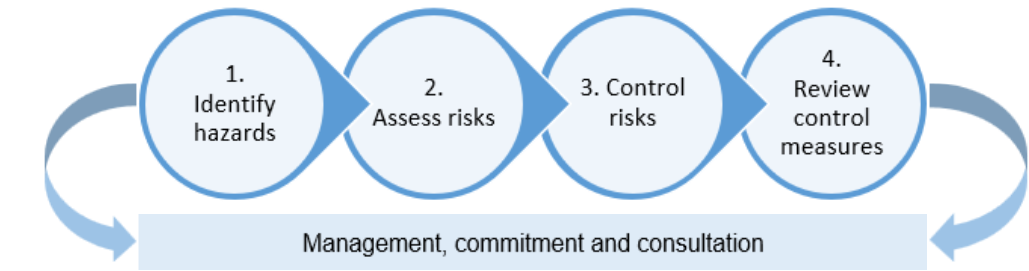
Figure 1 - HSW risk management process
When the process must be applied:
- anytime a new task, activity or change is identified
- when planning changes to tasks, activities, environments, plant/equipment
- when a hazard is reported or an incident occurs
- when controls may have changed or stopped working
- when legislation, a procedure or an audit requires it
- at regular intervals appropriate to the risk level.
1. Identify hazards: find out what could cause harm
Persons in charge of a workplace/school must implement and maintain site-specific processes, aligned with the department HSWMS, to identify hazards. This includes:
- understanding the context of the hazards - who is involved, where the work happens, what skills and experience people have, and what rules or legal requirements apply
- identifying hazards - things, situations or activities that could cause physical or psychological harm
- using a range of methods to identify hazards - talk to workers and HSRs, inspect the workplace, use the checklists, review incident records, safety communications and manufacturer information
- recording all identified hazards - a register of known and potential hazards must be maintained at all workplaces and schools using MyHR WHS.
Workplace/school supervisors, managers and delegates, are responsible for ensuring all workers within their area of responsibility understand and apply these processes.
2. Assess risks: understand how likely and how serious
Workplace/school supervisors, managers and delegates, are responsible for ensuring that risk assessments are undertaken and approved at the appropriate level for hazards identified within their area of responsibility, in accordance with site-specific processes aligned to the Managing HSW Risk Guideline and/or any applicable hazard-specific procedure.
Risk assessments help to understand the potential likelihood and consequences of risks associated with identified hazards. Risk assessments may be documented (formal) or undocumented (informal/dynamic), this decision is based on how likely it is that harm will occur and how serious the consequences could be.
A formal documented risk assessment is required when:
- hazards, controls or their interactions are not well understood
- multiple hazards interact; a high consequence activity is planned
- a change may affect controls
- legislation or a procedure requires it.
A documented assessment is not required where the hazards, risks and controls are well known and understood. The required controls must still be communicated to and followed by all relevant persons.
To document risk assessments, use the correct department tool (see the Risk Assessment Tools Index). If no specific tool exists, use the HSW Risk Assessment Template and follow the Managing HSW Risk Guideline.
For psychosocial hazards, consider additional methods such as surveys, focus groups and specialised templates.
Consult workers and relevant parties as part of the assessment process.
Persons in charge of a workplace/school must ensure risk assessments are completed and escalate high-risk matters to the parent HSW committee, direct supervisor or manager.
3. Control risks
A control is an action taken to eliminate or minimise health and safety risks so far as is reasonably practicable.
If risks cannot be eliminated, the hierarchy of controls must be used to minimise the risk as far as reasonably practicable.
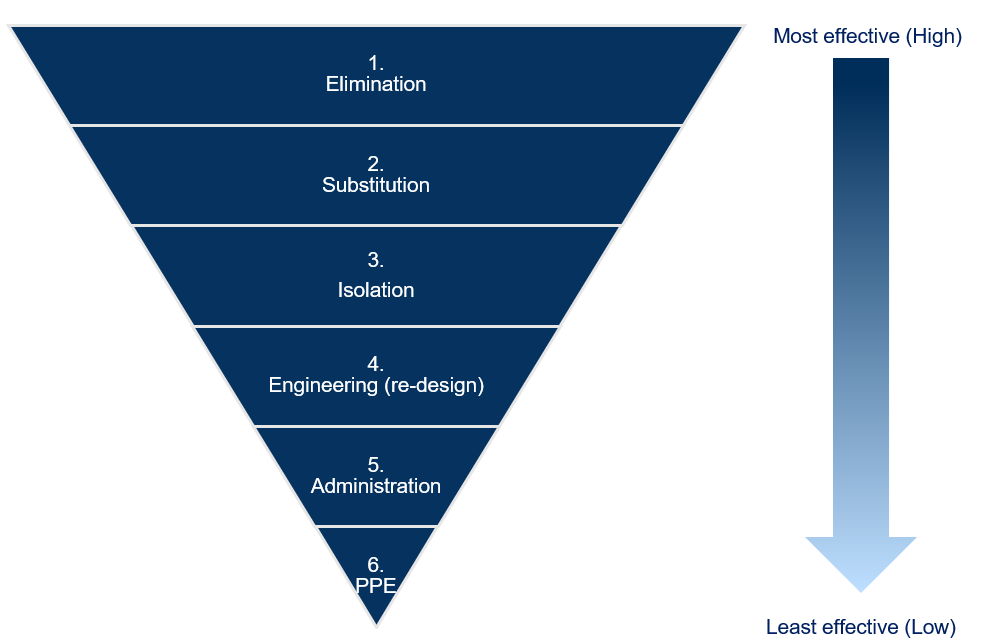
Figure 2 - Heirarchy of controls
When applying controls, persons in charge of a workplace/school, workplace/school supervisors, managers and delegates must:
- consult with affected workers and relevant stakeholders
- apply the hierarchy of controls, prioritising higher order controls
- use more than one control where a single measure is insufficient to eliminate or mitigate the risks
- meet all legislative requirements and comply with department policies and procedures, as a minimum standard at all times
- rate the residual risk using the HSW risk matrix. If the risk is not at an acceptable level, add more controls before proceeding
- accept a medium or high residual risk only where the risk cannot be reduced further and the hazard cannot be avoided (e.g. driving). This must be fully assessed, documented and approved at the appropriate authority level, in accordance with site-specific processes aligned to the Managing HSW Risk Guideline and/or any applicable hazard-specific procedure
- ensure psychosocial hazard controls focus on the design and management of work, supported by site-specific processes, supervision, training and clear processes for managing HSW issues, complaints, conflict and incidents. Where risks cannot be eliminated through work design, implement additional controls such as training, instruction and support processes
- ensure the completed risk assessment is approved by an authorised risk approver before work proceeds
- ensure all affected workers are aware of, and familiar with, the risk assessment control measures.
Additional requirements:
4. Review controls: make sure they continue to work
Risk management is an ongoing process. Persons in charge of a workplace/school must ensure there is a process in place to regularly check that the controls are in place and effective. This process should:
- check that controls are in place and working, with review frequency reflecting the level of risk
- assign a nominated person to be responsible for maintaining each control
- keep plant, equipment, training, procedures and hazard information current
- encourage workers to report new or changed hazards (including psychosocial hazards) as they are identified
- use workplace inspection checklists to verify that controls are effective
- review risk management performance through regular HSW committee meetings and escalate unresolved issues to the appropriate authority level as outlined in the HSW governance structure
- support the Annual Safety Assessment activity.
Workplace/school supervisors, managers and delegates are responsible for using this process to ensure that controls assigned to their area of responsibility are implemented, maintained and remain effective.
Consultation
Consultation with workers is a legal requirement under the
Work Health and Safety Act 2011 (Qld) (WHS Act). It must occur throughout the risk management process, not just at the assessment stage.
Persons in charge of a workplace/school must have site-specific processes that gives workers, or their representatives, the chance to have a say before decisions are made about the hazards or risks that affect them. They must also ensure hazards and risk controls are communicated to all relevant persons.
Consultation may take place through HSW committees, HSRs, team meetings, surveys, direct discussion or a combination of these.
Documentation and records
Persons in charge of a workplace/school must have a site-specific process to store and maintain risk assessments and related records in line with:
Records must be accessible for review, audit, incident investigation, and any authorised request, inspection, or compliance activity.
Risk assessments must be kept current and reviewed whenever a change may affect the hazard, the level of risk or whether controls are still working.
Definitions
|
Term
|
Definition
|
|
Acceptable level (for risk)
|
The risk is consistent with the department's risk appetite and the legislative requirements for risk have been achieved (i.e. the risk is eliminated or minimised as far as reasonably practicable)
|
|
Consequence
|
The outcome (HSW impact) of an event which affects the department's ability to achieve its objectives. The risk matrix defines these as: insignificant, minor, moderate, major, serious, or critical.
|
|
Control
|
Any existing process, policy, device, system, practice or other method aimed at reducing the likelihood or consequence of a risk.
|
|
Hazard
|
A situation, thing or activity that has the potential to cause/result in HSW harm.
|
|
Hierarchy of controls
|
A ranking of controls from the highest level of protection and reliability to the lowest as required to be applied by WHS regulation. They include elimination, substitution, engineering controls, administrative controls and personal protective equipment. For details see Managing HSW risk guideline.
|
|
Likelihood
|
The chance or probability of the risk consequence occurring as a result of the risk event
|
|
Reasonably practicable
|
Reasonably practicable means that which is, or was at a particular time, reasonably able to be done in relation to ensuring health and safety, taking into account and weighing up all relevant matters including:
- the likelihood of the hazard or risk occurring
- the degree of harm that might result from the hazard or the risk
- what the department (through its officers and workers) knows, or ought to reasonably know, about the hazard or risk and the ways of eliminating or minimising the risk
- the availability and suitability of ways to eliminate or minimise the risk
- after assessing the extent of the risk and the available ways of eliminating or minimising the risk, the cost associated with available ways of eliminating or minimising the risk, including whether the cost is grossly disproportionate to the risk.
|
|
Residual risk
|
This is the level of risk with existing controls in place. The current risk level is reassessed at each review cycle after considering the impact of controls and actions.
|
|
Risk
|
The effect of uncertainty on the achievement of objectives and for HSW the possibility that harm (death, injury or illness) might occur when exposed to a hazard. Risk is measured in terms of consequences and likelihood.
|
|
Risk approver
|
The authorised/appropriate delegate listed in the risk assessment template or guidelines or if none indicated an appropriate supervisor or manager who signs off/approves the risk assessment.
|
|
Risk level
|
The risk level derived from the HSW risk matrix after considering the consequence and likelihood of the risk (typically expressed as low, medium, high, extreme).
|
|
Worker
|
A person is a worker if the person carries out work in any capacity for the department.
|
|
Workplace
|
A location where work is carried out by and for the Department, including any place where a worker goes, or is likely to be, while at work (including conferences, professional development seminars, excursions, out of office-based work areas, camps and travelling in vehicles, vessels, and aircraft).
|
Legislation
Delegations/Authorisations
Other resources
Superseded versions
Previous seven years shown. Minor version updates not included.
Nil